
Have you ever wondered how money really works? Would you like to protect your financial future in an increasingly uncertain world? If the answer is yes, this article helps you understand the fundamental mechanisms that shape our daily economy.
Money is one of the most powerful communication tools ever created by human beings, and understanding how it works can make a real difference to your future well-being.
Basic concepts to remember
- Money: a physical or digital tool that allows people to exchange value.
- Market: cooperation and voluntary exchange of value between individuals.
- Economy: the discipline that studies how markets and exchanges work.
The evolution of money
At first, human beings used barter, meaning the direct exchange of goods such as food, tools or clothing. This system had obvious limits: what happens when what you receive in return is not useful to you or deteriorates quickly?
To solve these problems, forms of money based on recognized goods emerged: salt, shells, precious metals such as gold and silver, and eventually banknotes. These tools had three essential qualities: ease of exchange, divisibility and the ability to store value over time.
The role of trust
The value of any currency depends on the trust that people place in it. If you were thirsty in the desert, you would probably choose a bottle of water over a kilo of gold: perceived value changes depending on context and practical usefulness.
Collective trust is therefore what makes a currency accepted, used and relatively stable over time.
The problem of inflation
Inflation is the loss of value of a currency, often caused by an increase in the amount of money in circulation. If the amount of money grows but real goods do not increase, prices tend to rise. Rising prices are not inflation itself, but the most visible consequence of it.
Who creates money
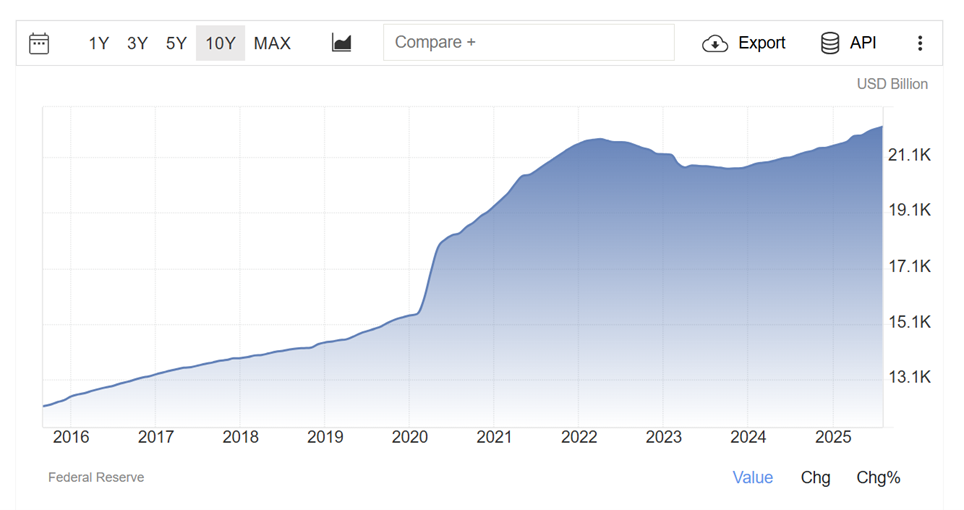
Money creation is managed by central banks, such as the ECB in Europe or the Federal Reserve in the United States. Commercial banks also contribute through the fractional reserve system, effectively increasing the amount of money in circulation.
Over recent decades, many European families have felt this erosion of purchasing power in concrete terms: for the same standard of living, it is now often necessary to work more or take on greater financial risk.
Money today: the fiat system
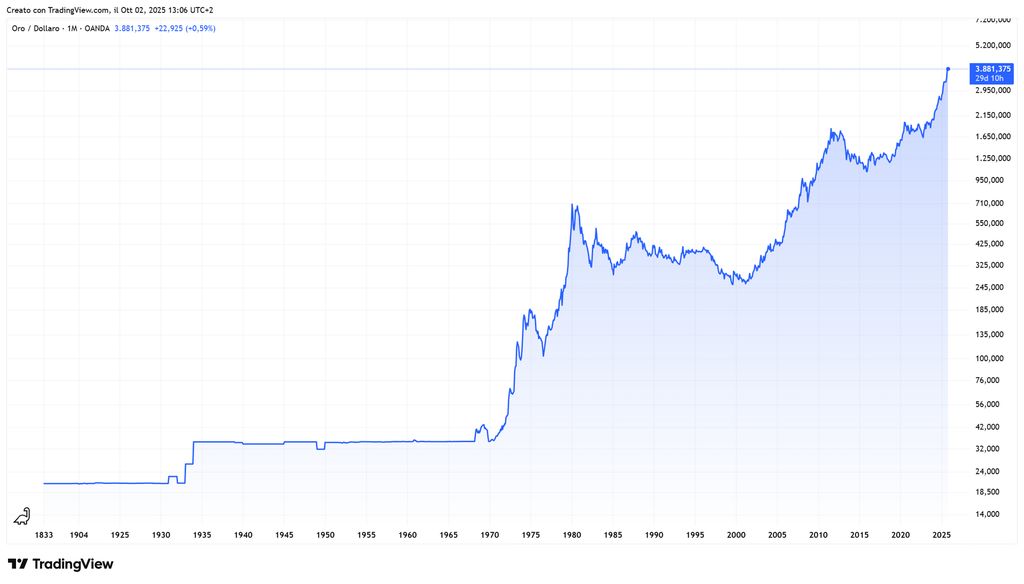
Banknotes were originally born as receipts for gold deposits held at banks. Under the gold standard, each banknote theoretically represented a real underlying value. In 1971, the United States definitively abandoned this system, opening the era of fiat money.
Fiat money is no longer backed by a physical asset like gold: its value depends on trust, monetary policy and the legal framework that imposes it as a means of payment.
The consequences of the current system
The shift to the fiat system radically changed the relationship people have with savings. Decades ago, building capital over time was easier; today, without investment or exposure to risk, preserving the value of savings has become much harder.
A possible solution: Bitcoin
Bitcoin was created as a decentralized digital monetary alternative. It is a system that does not depend on central banks or governments and is based on publicly verifiable mathematical rules.
- It allows direct exchange of value between people, without intermediaries.
- It enables individuals to maintain direct control over their funds.
- It operates in a transparent system that can be verified by anyone.
Conclusion
Understanding how money works is not just a technical matter: it is a fundamental skill for protecting your future. In a context where inflation erodes savings, learning about the available alternatives becomes increasingly important.
Financial freedom starts with knowledge: only by truly understanding money can we make more conscious choices for ourselves, for our business and for our future.
Would you like to bring Bitcoin into your business?
If you want to understand how to accept Bitcoin and Lightning Network payments in a simple, credible and practical way, you can request a dedicated consultation.